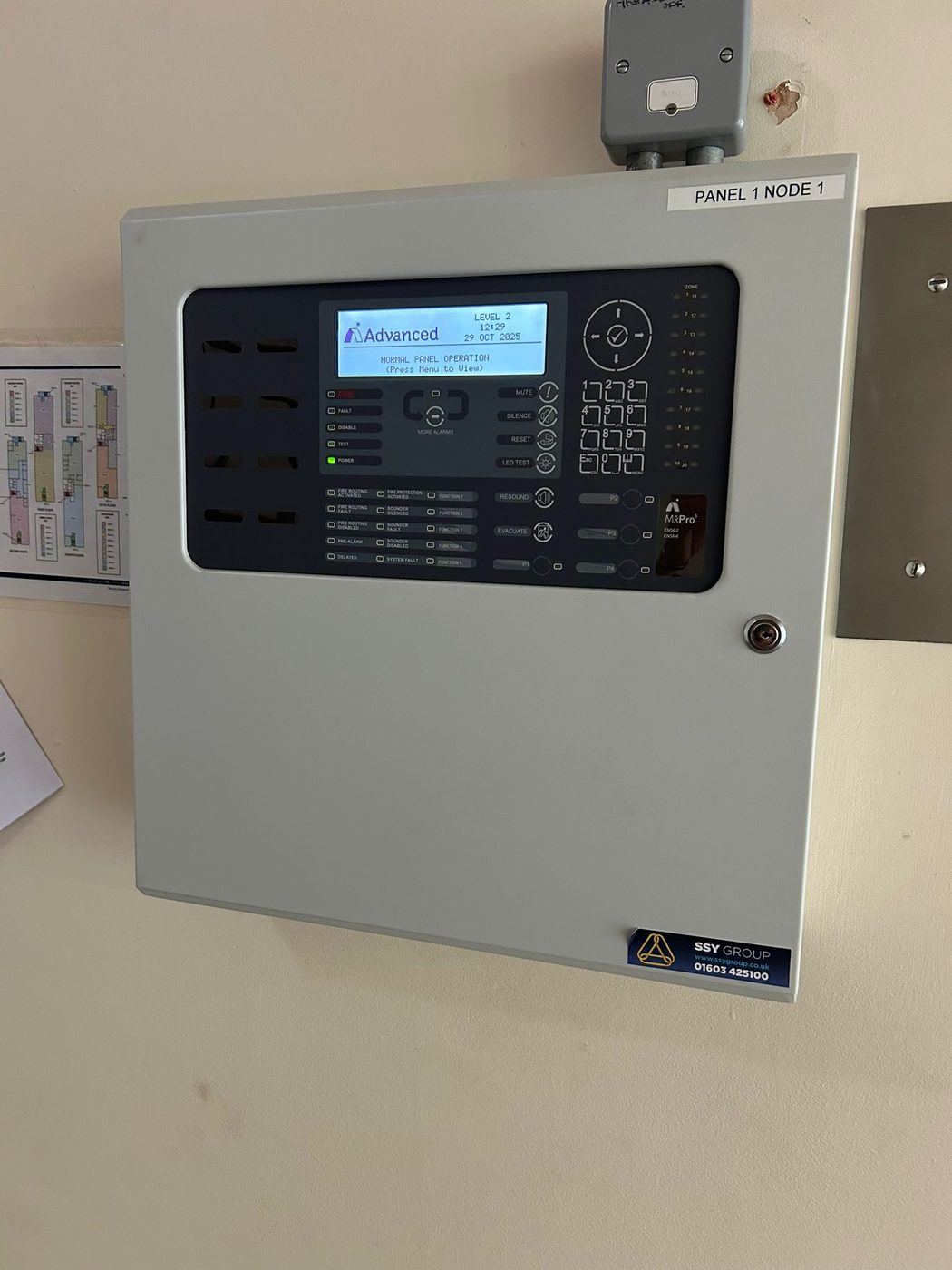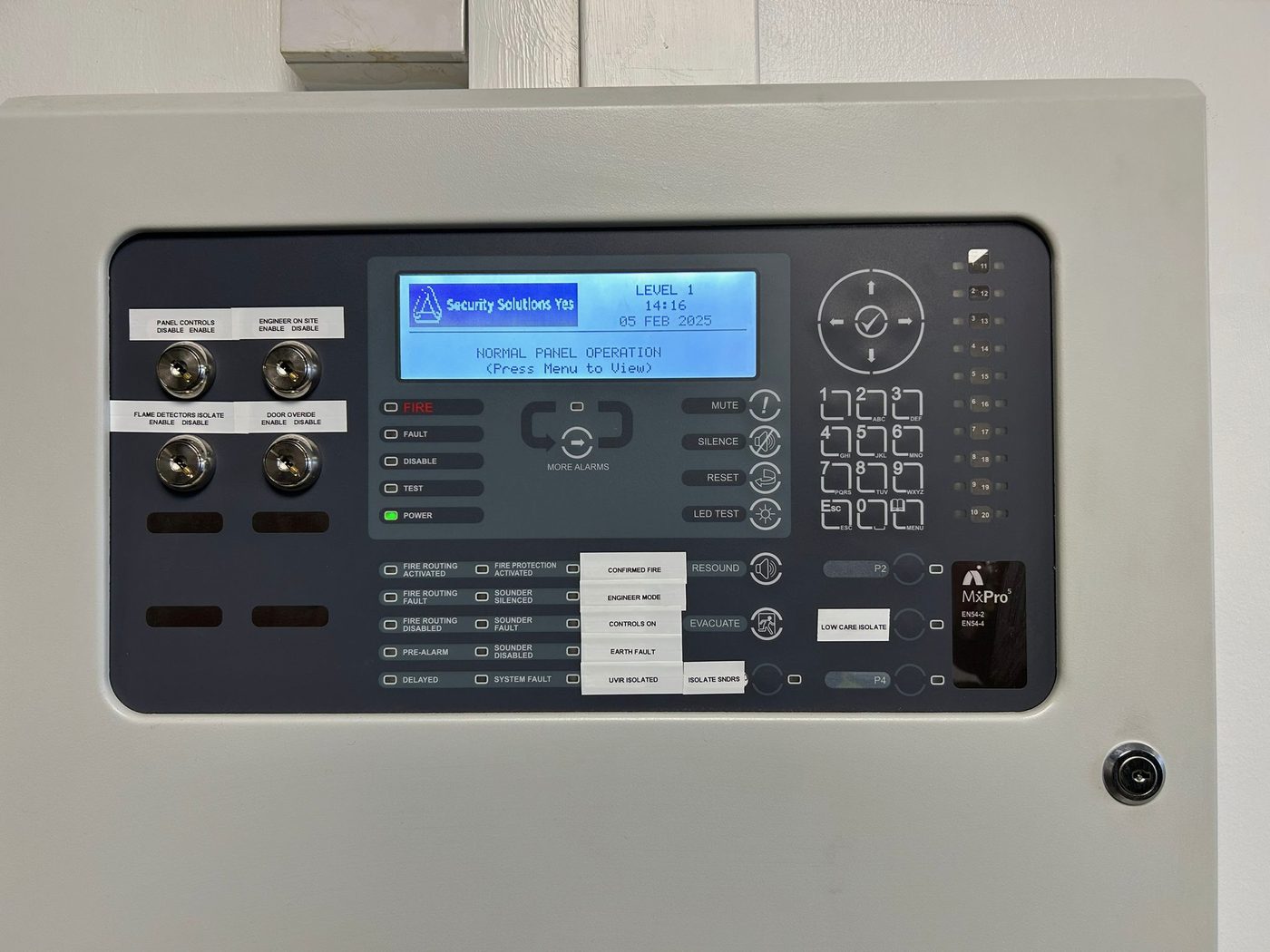
Commercial fire alarm systems: the short answer
A commercial fire alarm system detects fire, warns everyone in the building and, where needed, signals to a monitoring centre. Almost every UK workplace needs one under the Regulatory Reform (Fire Safety) Order 2005, and BS 5839-1:2025 is the standard used to design, install and maintain it. The category, from M through L5 to L1 or P1, comes from your fire risk assessment. As a guide from our own invoices, a new system for small premises cost £2,500 to £3,000, confirmed at a free survey.
The standards that apply
Regulatory Reform (Fire Safety) Order 2005. The law in England and Wales. It makes the responsible person, usually the employer, owner or managing agent, accountable for fire safety, including appropriate detection and warning and keeping it maintained in efficient working order.
BS 5839-1:2025. The code of practice for fire detection and alarm systems in non-domestic premises, in force since 30 April 2025. It sets the system categories:
- M: manual call points and sounders only, no automatic detection.
- L1: automatic detection throughout the building, for life safety.
- L2: as L3, plus defined high-risk areas such as kitchens or rooms where people sleep.
- L3: escape routes and the rooms that open onto them.
- L4: escape routes and circulation areas only.
- L5: detection in a specified area to meet a defined fire safety objective.
- P1 and P2: property protection, throughout the building or in defined high-risk parts.
Categories can be combined, such as L2/P2. The 2025 edition also made a missing zone plan an unacceptable variation where there is more than one zone, recommends smoke, multi-sensor or carbon monoxide fire detection rather than heat detection where people sleep, and expects every variation to be recorded. Our BS 5839-1:2025 compliance guide explains the changes.
BS 5839-6. Covers domestic premises and houses in multiple occupation, with its own grades (A, C, D1, D2, F1, F2) and categories (LD1 to LD3, PD1 and PD2). Mixed buildings can need both parts, as the fire risk assessment directs.
BS 7273. Covers how a fire alarm triggers other fire protection measures. Part 4 applies to door release, including access-controlled doors and door holders, and Part 1 to gaseous extinguishing systems. Every interface we fit is designed into the cause-and-effect and proved at commissioning.
How a fire alarm project runs
- Survey. We review your fire risk assessment, walk the building, check cable routes and assess any existing system. Free.
- Design and specification. Category, device layout, panel type, zoning, interfaces and signalling, with a design certificate listing any agreed variations.
- Quote. Itemised and stating the category it is designed to. Certificates, zone plan and commissioning are included, not extras.
- Installation. Fire-rated cabling, panel and devices, phased around an occupied building where needed.
- Commissioning and certification. Every detector, call point, sounder and interface tested, certificates issued on the 2025 model forms, and a False Alarm Notice fitted where there is an automatic link to the fire and rescue service.
- Handover and training. Zone plan at the panel, log book, as-fitted drawings, cause-and-effect schedule, and training for the responsible person on the weekly test and the false alarm log.
- Maintenance. Servicing about every six months, every device tested over the year, and fault response.
What's included in the price
Our installation quotes include design, materials, labour, commissioning and certification. Every new installation comes with design, installation and commissioning certificates, a zone plan, a log book, as-fitted drawings, a cause-and-effect schedule where there is one, and handover training. We don't charge extra for the certificate on an installation. Signalling to an alarm receiving centre and ongoing servicing are quoted separately, and older buildings may need a separate asbestos survey before drilling.
How much does a commercial fire alarm cost?
These figures come from our own invoices and quotes, set out in full in our commercial fire alarm cost article. They exclude VAT and are guide prices, confirmed at a free survey:
- Adding or replacing a few detectors or call points: £388 to £880
- Replacement control panel: £449 to £674
- New or replacement system for small premises: £2,500 to £3,000
- Full upgrade or new addressable system for a mid-sized commercial building: £10,000 to £11,300
- New or replacement systems we quoted in September 2026: about £2,400 to £18,600, with half below £6,000
Servicing is separate. Across 52 of our fire alarm maintenance contracts the median was £304 a year, and half of sites paid between £216 and £505. Monitoring adds £50 to £100 a year for a basic signalling path, or £150 to £350 for a monitoring contract. See our fire alarm servicing cost article, or use the pricing calculator for an indicative range.
Who needs a commercial fire alarm in East Anglia
- Food production and manufacturing: heat or multi-sensor detection where steam, dust or cooking would trouble smoke detectors, and plant shutdown interfaces.
- Logistics and warehousing: beam detection under high roofs, and property protection categories that insurers often specify.
- Care homes: detection suited to sleeping risk, and remote monitoring, whose absence where it is needed BS 5839-1:2025 treats as an unacceptable variation.
- Schools and colleges: large, busy sites zoned clearly, with door holders on fire doors.
- Offices and retail: commonly L3 or L4 systems, often conventional panels in smaller units.
- Housing: common parts of blocks and HMOs, where BS 5839-1 and BS 5839-6 often meet.
Fire alarm servicing, testing and monitoring
BS 5839-1:2025 expects a service about every six months, falling five to seven months after the previous visit, with every device tested at least once a year and a weekly user test operating a different call point each week. Our engineers check the log book, batteries, interfaces and signalling, and issue an inspection and servicing certificate. Maintenance contract customers get a 4-hour response to emergencies and a same-day response to non-emergency faults. Where nobody on site can do the weekly test, we can, typically for £45 to £90 a visit. See how often a fire alarm should be tested and serviced.
Guides and further reading
- How Much Does a Commercial Fire Alarm Cost? These are from our actual prices!
- Fire alarm certificates: which ones you need, who issues them and what they cost
- How much does fire alarm servicing cost? What 52 of our maintenance contracts charge
- How often should a fire alarm be tested and serviced? The BS 5839-1:2025 schedule
- Three Fire Safety Changes Taking Effect in 2026